
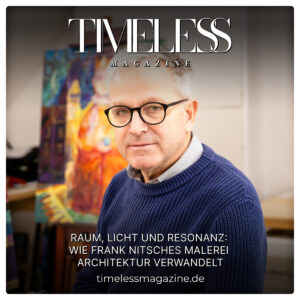


Raum, Licht und Resonanz: Wie Frank Nitsches Malerei Architektur verwandelt
.JPG)
.jpg)
.jpg)
.JPG)
Painting as a spatial impulse
Anyone who engages with Nitsche’s images in relation to spaces can embark on a journey of discovery in two senses. This is because spaces already play a central role within the artist’s compositions. His motifs are characterized by layering, movement, and depth. Areas of color overlap, revealing figures and then allowing them to disappear again. This process creates a visual dynamic that expands spaces. His works thus unfold a special power, particularly in clearly structured architectures and environments. They create points of contrast. Where lines appear strict and cool, Nitsche’s artworks bring emotional openness and warmth. They break up rigid geometries and create tensions that make the spaces tangible and alive. Since the painter’s works already use yellow tones to illustrate light and shadow, an exciting resonance with the surroundings is created. This results in an atmospheric interaction, especially in light-flooded interiors.
Architecture as a stage – stage as a space
Many of Nitsche’s images resemble small stages. Figures stand in the light, spaces open up, depths emerge. This theatrical structure corresponds directly with architectural spatial concepts. His works invite viewers to move around the space, change perspectives, and seek proximity. In foyers, waiting areas, hotel lobbies, or prestigious living spaces, his works play a quiet but formative role. They create a pleasant atmosphere, generate emotional anchoring, and promote identification. The space is not just passed through—it is experienced. Especially in semi-public spaces—law offices, doctors’ offices, educational institutions, cultural centers—his paintings have a calming yet activating effect. They relieve nervousness, open up spaces for thought and feeling, and promote concentration and relaxation in equal measure. The childlike, poetic imagery does not come across as naive, but rather as clever: it appeals directly without overwhelming. This is a central feature of Frank Nitsche’s art.
Small formats, big spatial impact, and the power of color
A central characteristic of Nitsche’s work is his preference for working in small and medium formats. This decision is no coincidence, but rather a conscious spatial psychological device. Small pictures force the viewer to come closer. They draw the viewer out of the distance and create intimate moments in the architectural context. Especially in spacious rooms, these formats generate an unexpected intensity. Instead of monumental dominance, a dialogue at eye level emerges. The pictures set subtle accents and structure wall surfaces in a very subtle way. In addition to the formats, color plays an important role in the artist’s works. It is not purely an aesthetic device, but an emotional stimulus. The warm yellow, red, and orange tones in particular exude a sense of security and openness. Cool blue and gray tones complement this with depth, concentration, and calm. These qualities can be put to excellent use in interior design. Especially in environments of communication—such as restaurants, waiting areas, and event rooms—they promote exchange and curiosity. Color has a particular strength in today’s architecture, which is very often characterized by neutrality and reduction. It brings life to rooms without being distractingly loud. Nitsche’s art—and this is also a central motif of the artist—wants to speak quietly and be discovered.
Art as an integral part of spatial design
Frank Nitsche’s paintings are not suitable as retrospective decorative elements, but rather as an integral part of holistic interior design concepts. They can be incorporated into planning processes at an early stage. The works thus offer designers and architects in particular the opportunity to define spaces emotionally. They help to make spaces moving and thus memorable. In other words, those who engage with the works are not investing in art as an object. Rather, they are investing in emotional depth and spatial quality. In this way, the paintings give rooms something that they cannot create on their own: human resonance.
Further information and currently available works:
Raum, Licht und Resonanz: Wie Frank Nitsches Malerei Architektur verwandelt
Wenn Räume erinnern lernen – Jochen Ulmers Malerei als seelische Erweiterung von Architektur
