
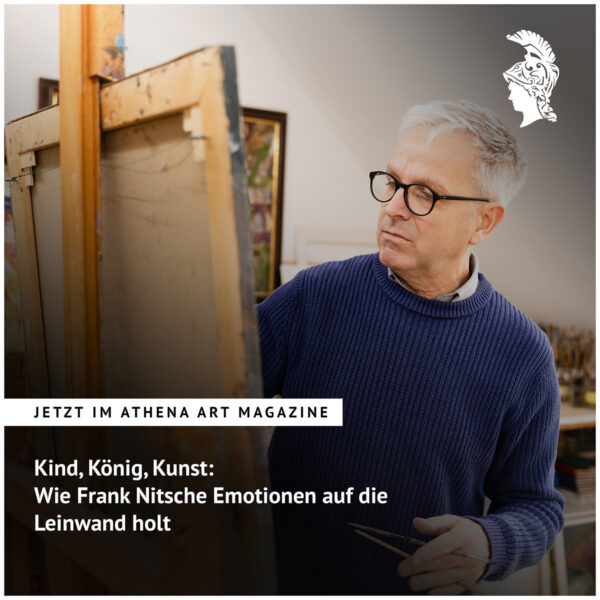

His art speaks softly—yet powerfully. And it can only be truly understood in the context of his biography, attitude, and practice. One thing is clear: Frank Nitsche’s work touches entire generations. His works are playful, colorful, and imbued with light – yet at the same time full of seriousness. They arise from a life between system and freedom, between mathematics and painting, between pedagogy and artistic autonomy. We talked to him about what lies at the heart of his paintings.
Studying art at 41
Art has always been part of his life. Even as a small child, Nitsche stood out for his intense drawing. However, studying art was not possible for him in the confines of the GDR. Instead, he studied mathematics and physics, passed two state examinations, and became a teacher. But art always remained a silent companion. During his studies, he met the artist Paul Otto Knust. A person whom Nitsche now describes as an important mentor and father figure. In his studio, a space opened up for the first time where art was not only possible, but existential. “That turned on the turbo. I was allowed into the studio—and suddenly everything was there,” says Nitsche. With the fall of the Berlin Wall, not only did the system change, but so did the life orientation of the once conformist mathematician. He left the teaching profession and began studying art in Halle and Leipzig. Nine semesters later, he graduated again with a state examination—this time as an art teacher.

A children’s world with a crack
Expressionistic-looking areas of color combined with childlike figures. Thematically, Nitsche’s paintings revolve around a motif that is deeply rooted in his biography: the lost paradise of childhood. The early move from a house with a garden to an anonymous new housing development became for him the primal scene of loss – and at the same time the source of his visual world. His painting creates small, colorful worlds, often populated by children, depicted as kings, jesters, sailors. They are stage sets of life, full of light, movement, and lightness. But always with breaks, shadows, seriousness. “It’s a children’s world – but always with a disturbance in it.” It is precisely this ambivalence that makes the works accessible. They reject pure escapism as well as a gloomy worldview. For Frank Nitsche, art is not a cry of protest, but a celebration – for the eyes and the soul.
Frank Nitsche does not paint impulsively between appointments, but consistently as part of a clearly structured daily routine. His studio is located in the attic of his house—a large, enclosed room that he deliberately defines as a place of retreat. He never paints at night, only during the day. And creativity comes after order. Paints, brushes, canvases. Everything must be neatly arranged and ready to use. Unfinished business must be completed. He describes painting itself as a quiet, concentrated immersion into the wonder world of children. The result is a work that is deeply personal and yet remains open. Frank Nitsche does not paint answers. He builds spaces – and invites us to enter them.
%20Kopie.jpg)
Confidence as an artistic principle
What Nitsche wants to inspire in his audience is clearly articulated: courage, joy, and enthusiasm for one’s own creative endeavors. His exhibitions are not transitional spaces, but meeting places. People who otherwise have little contact with contemporary art find access to it—often surprisingly quickly. This reveals a deeply rooted pedagogical conviction. Art as an opportunity to remain true to oneself. Not to bend to others’ will and not to want to control everything. His works aim to touch, not to impress. Even if they often do both. It is not uncommon for collectors to leave his studio with several works.
%20Kopie.jpg)
Art as an educational bridge
Nitsche is not only an artist, but also a committed art educator. Back in 1990, he founded a youth art school, later followed by the Kreativwerkstatt Aschersleben, a large interdisciplinary center for artistic work. There, studios for painting, ceramics, textile art, and dance were created. This educational work is not a byproduct of his artistic creation, but a central component of his approach. According to Nitsche, art is not an exclusive space for insiders. “Basically, anyone can paint. You just can’t get too intellectual about it,” he says. His proximity to working with children and young people also shapes his own painting. He repeatedly talks about how much the immediacy of young people inspires him. The playful, the courageous, the imperfect—all of this finds its way onto the canvas.

Artist Frank Nitsche in his studio
For further information and currently available works, visit: