
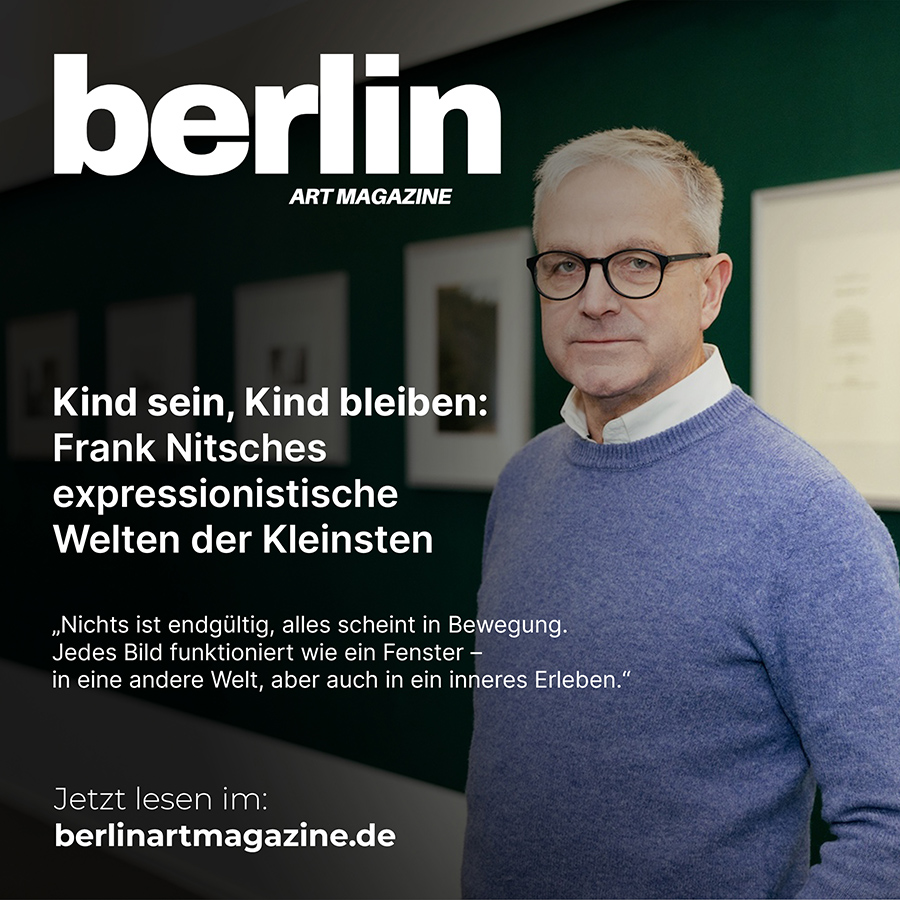

Frank Nitsche’s paintings demand closeness. They do not hang at a distance; they do not make an impact from afar. You have to step closer, almost press your nose against the surface, to understand what is happening here. Patches of color overlap, lines dance, figures appear and vanish again. Nothing is permanent; everything seems to be in motion. Each painting functions like a window—into another world, but also into an inner experience.

Painting as Shift Work
For Nitsche, the creative process begins long before he even approaches the canvas. He draws daily in dozens of sketchbooks: people, animals, spaces, memories. These drawings do not serve as templates, but as a reservoir of ideas. On the canvas itself, abstract patches of color emerge first—“colorful pebbles,” as he calls them. Only later do figures find their place. Cats, children, sailors, kings appear, are reworked, and disappear again. “My paintings often have a history of six or eight years.” Dissatisfaction is not a flaw here, but a driving force. Many works are sanded down, destroyed, and rebuilt. Palettes, sandpaper, and new layers of paint create a depth that one not only sees but feels. Nitsche’s painting thrives on a productive tension: free play and structural order. As a trained mathematician, he loves systems, rhythms, and balance. At the same time, he resists the compulsion for perfection. For him, Expressionism and abstraction are means of making emotional truths visible—not anatomical correctness. Lines are allowed to jump, forms to dissolve. “A person doesn’t have to be painted perfectly—what matters is that it conveys how they feel,” says the artist from Aschersleben.
.jpg)
Stage, Roles, and the Power of Small Formats
Many of Nitsche’s paintings resemble scenes on a stage. Figures stand in the light; spaces open or close. This theatrical quality is intentional. The recurring roles—king, jester, sailor—are archetypal. They represent responsibility, reflection, and freedom. The sailor, in particular, serves as a point of escape: he is allowed to leave the room, to sail into the distance. And the lighting also plays an important role. Yellow stands for the sun, hope, gold. Yet there are always shadowed areas as well. Interior spaces, gloom, confinement. Freedom is not simply claimed—it must be fought for. So why small? For Nitsche, the answer lies in intensity. Large formats quickly lose their density for him. In the small painting, on the other hand, a “brilliant effect” emerges: depth, luminosity, concentration. “I want people to get very close.” Proximity creates intimacy. Each painting is addressed to a single viewer, not to a group. It is in this quiet encounter that the true impact of his painting unfolds. Thus, works emerge that speak softly and resonate for a long time. Frank Nitsche’s paintings do not demand attention—they command it.
.jpg)
An Established Presence Beyond the Fast-Moving Market
Frank Nitsche’s artistic success does not follow a traditional gallery or art fair trajectory, but is the result of sustained effort. Since the early 2000s, he has regularly exhibited his work in solo shows, including in Saxony-Anhalt, Brandenburg, Saxony, and Baden-Württemberg. A major highlight was the large-scale retrospective in 2023/24 at the Kunstquartier Grauer Hof in Aschersleben. The exhibition featured 250 works spanning several decades—a retrospective that brought together his oeuvre on this scale for the first time. His work is also recognized beyond the art market: for his commitment to cultural education, he has been honored with, among other awards, the City of Aschersleben Education Prize and the Salzlandkreis Volunteer Award.

Weitere Informationen unter:




.jpg)


