Professor Josef Walch (Burg Giebichenstein University of Art and Design Halle) on the paintings of Frank Nitsche
Frank Nitsche studied at the Burg Giebichenstein University of Art and Design in Halle – where we met – and was a guest student of Ulrich Hachulla at the Leipzig Academy of Visual Arts. He received crucial inspiration very early on during his teacher training studies in Halle from the painter Paul Otto Knust, an artist of the Classical Modern period, often referred to as the “lost generation” due to their biography. Knust was a master student at the Halle University of Art and Design under Charles Crodel, and he introduced Frank Nitsche to what would later become central to his own studies: the study of artistic fundamentals such as the study of nature, composition, and anatomy/morphology (from the Greek μορφή, morphé, “shape, form,” and λόγος, lógos, “word, doctrine, reason”) as the study of forms and their transformation. It is a study of drawing that opens up a multitude of artistic avenues for the artist. In this context, one can also quote Albrecht Dürer with his famous saying: “Everything the artist wants to possess, he must tear out of nature.” “Reißen” is the Old High German word for drawing.
Frank Nitsche’s many sketchbooks document this process. Anatomy, in particular, and the fascination with human forms, which possesses an intellectual and scientific dimension, remain of great importance to many artists, even those who do not work figuratively. The “Leipzig School,” spearheaded by Neo Rauch, serves as an example. The website of the Dresden Academy of Fine Arts features the following recent quote on anatomy in the context of artistic study: “The ship of the mind rocks and rolls on the ocean of the body,” says Paul Valéry. For art students, mapping this ocean can be beneficial, perhaps even conducting some deep-sea explorations. The artist’s anatomy is an important tool in this cartographic process.
On the website of the Dresden Academy of Fine Arts, one can find the following quote on anatomy in the context of artistic study: “The ship of the mind rocks and rolls on the ocean of the body,” says Paul Valéry. “Although the surface of the human body reveals its internal structure with surprising accuracy, it cannot provide us with a satisfactory answer about its composition, function, and architecture. For the purpose of anatomical and graphic understanding, we must think and proceed from the inside out, using various illustrative aids, models, and graphic explanations.” (Paul Valéry)
The term cartography, mentioned here, seems to me particularly suitable for describing Frank Nitsche’s artistic method. Cartography is the science and technique of representing the Earth’s surface in topographic and thematic maps. Cartography illustrates spatial information.
The subjects of cartography are the Earth and its surface with its diverse topographical features. In this sense, Frank Nitsche maps his subjects and their topographical features, be they still lifes, interiors, or landscapes, a group of bottles on a table, an old armchair in a room, or the historic facades of Venice. Frank Nitsche analyzes surfaces and forms and repeatedly develops “image topographies” in different formats, to which he gives an emotional dimension through the use of color.
Wassily Kandinsky captured this process in the following image: “Color is the key, the eye is the hammer. The soul is the piano with many strings. The artist is the hand that purposefully sets the human soul vibrating by means of this or that key.”
Frank Nitsche almost consistently calls his depictions “Views from Within” (just as an anatomist gains “views from within” through his work). This refers not only to the figure, which is the primary focus of Nitsche’s prints, but also to subjects such as still lifes, interiors, cityscapes, and landscapes. In his images, Nitsche attempts to uncover the inner workings of the everyday objects and situations that surround us; he dissects them to reveal new and surprising perspectives.
The important Symbolist painter Odilon Redon famously said: “Before a painting depicts a landscape, a nude, or a still life, it is a flat surface covered with colors and forms.”
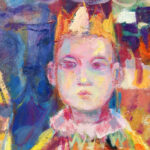
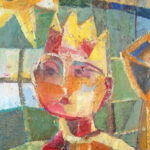
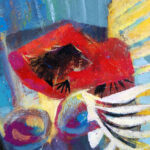
In Frank Nitsche’s paintings and prints, we encounter the external form of the depicted subject. This form manifests itself in Nitsche’s visual world in a multitude of ways: fragile, hollow, mysterious, cheeky, sensually seductive, or loud and assertive. Through the color scheme—color possessing a high emotional value in these images—in and around the subject, further insights into the essence of the depicted object are revealed. It is the process of transforming a natural form into an art form. Frank Nitsche manages to capture the character of an “armchair” (series) or a “pitcher” just as effectively as the unique charm of Venice’s scenery, constantly stimulating the artist’s imagination and leading to surprising visual inventions that transcend all clichés. The artist magically draws the viewer into his world of opulent colors, overflowing forms, and lighthearted subtext. The viewer sees and experiences a sensual painting and graphic art whose quality only truly reveals itself upon closer inspection. The small formats, in particular, invite the viewer into a very intimate dialogue. In lengthy painting processes, Frank Nitsche seeks, once the individual color tones are found, a vibrant interplay of colors, a harmony akin to that of a musical composition.
The artist’s paintings and graphic works are rich in sensory experience and quality, revealing their true character upon closer examination. Ernst Ludwig Kirchner, the great Expressionist, described this process as follows (1926): “The painter shapes the ocular conception [what a beautiful, old-fashioned term, J.W.] of his experience into a work. Through constant practice, he knows how to apply his means. There are no fixed rules for this. The laws for the individual work develop during the work itself, from the task; the type of technique from the personality of the creator… The sensual pleasure in what is seen [and Frank Nitsche knows how to convey this, J.W.] is the origin of all visual art from the very beginning… The instinctive intensification of form in the sensual experience is impulsively transferred to the surface.”